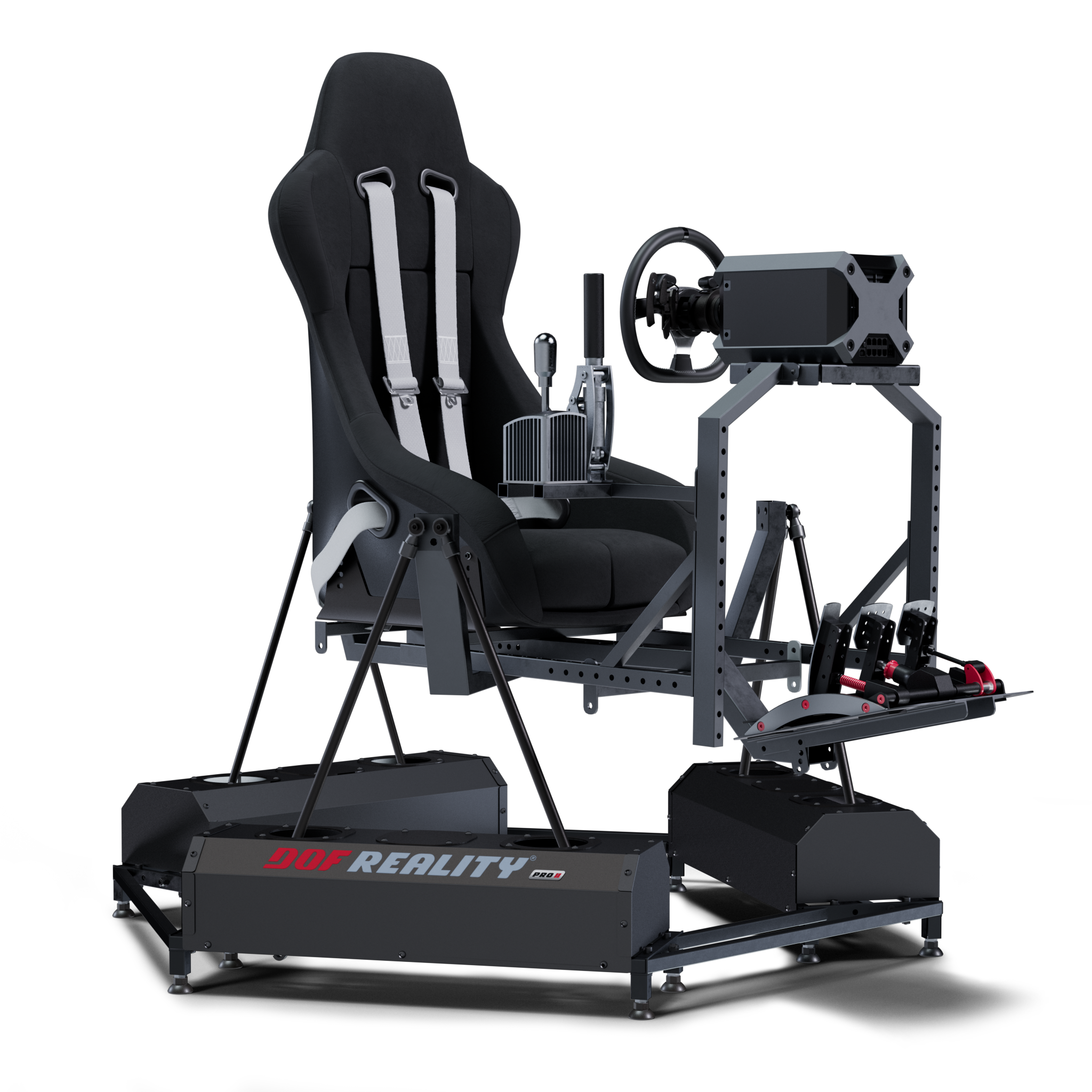
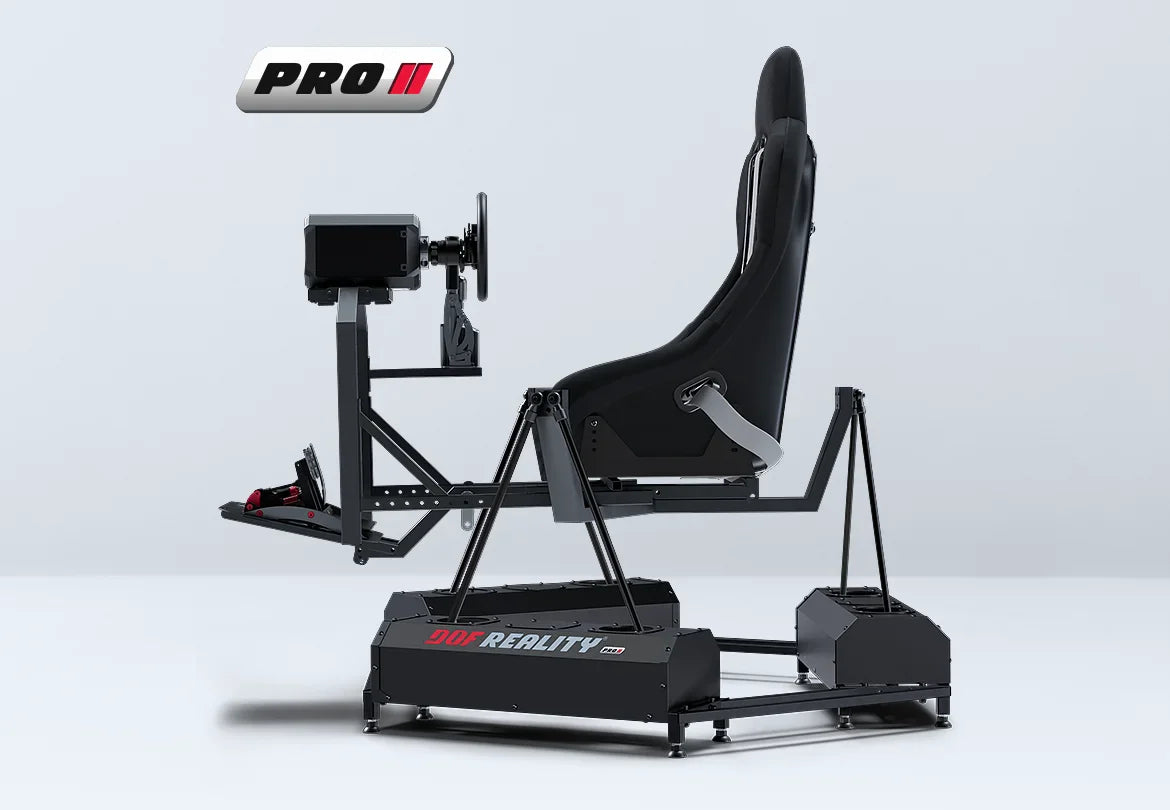
DOF Reality P6 6-Axis Professional Motion Simulator Platform
The DOF Reality P6 6-Axis Professional Motion Simulator Platform is a full six degrees of freedom system designed for continuous operation on a professional-grade chassis. Built to deliver complete motion capability, it supports heave, roll, pitch, surge, sway, and yaw for a wide range of simulation environments.
As the flagship model of the P-Series lineup, the DOF Reality P6 6-Axis Professional Motion Simulator Platform is engineered for advanced home users, simulator studios, VR venues, and training environments that require consistent and precise motion performance.
Compared to the enthusiast-focused H-Series, the P-Series features reinforced motors and upgraded drivetrain components designed for extended daily use. Combined with an industrial steel frame and a versatile mounting platform, the DOF Reality P6 6-Axis Professional Motion Simulator Platform supports applications including racing, flight simulation, helicopter training, trucking simulation, and VR-based experiences.
Designed for demanding setups, the DOF Reality P6 6-Axis Professional Motion Simulator Platform provides a stable and durable foundation for users who require full six-axis motion and reliable long-term performance.
Free shipping is included, allowing for a straightforward purchasing experience without additional delivery costs.

Product Features
Product Features:

What's Included:
What’s Included
DOF Reality P6 6-Axis PRO Motion Base
Professional 6DOF motion platform delivering heave, roll, pitch, surge, sway, and yaw for full-body simulation.
Universal Steel Frame
Industrial steel frame with adjustable mounting slots for seat, wheel or yoke, pedals, shifter or HOTAS, and cockpit accessories.
Motors, Actuators, and Gearboxes
Pre-installed P-Series motors with SFU-driven motion mechanisms, extra-smooth gearboxes, and complete linkage hardware.
Electronic Control Unit
Motion controller with motor outputs, safety systems, power input, and USB interface for PC connection.
Power and Data Cables
Region-specific AC power cable and USB cable for connecting the control unit to a computer.
Mounting Hardware
Bolts, washers, and brackets required for frame assembly and component mounting.
Setup and Software Guide
Documentation guiding assembly, motion software setup, and simulator integration.
Not Included: Seat, steering wheel or yoke, wheel base, pedals, HOTAS or collective, button boxes, displays, PC, or VR headset. These items are user supplied to allow custom cockpit configuration.
Product Specifications
Motion Type: 6DOF full-platform motion
Degrees of Freedom: Six axes including vertical, lateral, longitudinal, and rotational movement
Platform Style: Universal design supporting racing, flight, helicopter, truck, space, and custom simulations
Range of Motion: Up to approximately 17 degrees of pitch, roll, and yaw depending on configuration
Motion Speed: Up to approximately 75 cm per second under typical loads
Chassis: Industrial steel construction reinforced for commercial use
Supported Load: Up to approximately 200 kg combined user and cockpit weight, depending on setup
Motors and Drive: Professional P-Series motors with SFU-style drive and extra-smooth gearboxes
Input Voltage: 100 to 240 V AC, 50 or 60 Hz
Intended Use: Professional and commercial environments including arcades, simulation centers, studios, and training facilities
Getting Started Guide
-
Unbox and verify components
Unpack all items and compare them with the packing list to confirm all parts and hardware are present.
-
Select an installation area
Choose a flat, rigid surface with sufficient space for full platform motion and safe user access.
-
Assemble the steel frame
Bolt together the base, cross members, and supports, aligning everything before fully tightening fasteners.
-
Secure the P6 motion base
Position the motion base on the frame according to the manual and fasten it securely so it cannot shift during operation.
-
Mount seat and controls
Install the seat, wheel or yoke, pedals, and any shifter or HOTAS, adjusting ergonomics before final tightening.
-
Install accessories and check clearance
Attach any optional accessories and verify that the platform can move freely without obstruction.
-
Connect control electronics
Attach motor cables, connect USB to the PC, and plug in the AC power cable, keeping the system powered off until software setup is complete.
-
Install and configure motion software
Install compatible motion software, confirm device recognition, and select the appropriate P6 profile.
-
Run calibration and test motion
Power on the system and perform initial calibration and low-speed motion tests to confirm correct operation.
-
Link simulators and refine profiles
Enable telemetry in supported simulators and adjust motion intensity, smoothing, and axis limits for comfort and realism.
Setup and Installation Recommendations
Use a solid, level mounting surface to prevent flex and vibration.
Maintain at least 12 to 18 inches of clearance around the platform for safe motion travel.
Route cables neatly along frame members, leaving slack while avoiding moving parts.
Protect electronics with a quality surge protector or UPS.
Ensure all mounted components are securely fastened and within load limits.
Re-check fasteners after initial use and inspect periodically.
Use adjustable mounts if multiple users will operate the rig.
Enable motion compensation or tracking aids for VR setups.
Start with lower motion settings and increase gradually.
Keep firmware, software, and plugins up to date for best performance.

Add On Options:
6 DOF Transportation Wheels:

This option adds portability to the platform by installing two heavy-duty front wheels. The fully assembled platform can be lifted from the rear so the front wheels contact the floor, allowing easier movement as well as loading and unloading.
It is suitable for frequent repositioning within a space or during events and is compatible with H6 and P6 platform models.
Pedals Quick Release:

This quick-release add-on is useful for users who alternate between two pedal sets, such as flight and racing pedals. It allows pedals to be swapped quickly without remounting and also provides additional adjustment range, making it easy to slide a single pedal set forward or backward for quick positioning.
HoneyComb A+B Adapter:

If you have HoneyComb Alpha Bravo yoke and throttle this adapter will make them fit to our standard wheel plate.
Monitor Mount:

Now we offer VESA standard (100 mm × 100 mm) mount for one monitor up to 33lbs (15kg). Make sure you have the SFU gearboxes and the latest(wide) wheel support vertical bars before ordering it.

This Console Link (MagicBox) allows motion data to be received directly from supported console games without requiring a Windows PC. Motion is processed through compatible software and can be managed using a mobile device or tablet.
This option is intended for users who plan to use motion exclusively with console games and without a PC. It supports motion output only and does not replace other controllers such as steering wheels or pedals. The motion platform connects directly to the Console Link for console-based motion operation.
eBreak Stop Button (6 DOF):

E Break emergency button can be placed on the platform within a close reach to stop any platform motions immediately. It is compatible with any platform model.
HOTAS Mounts Kit:

Flight controls mounts kit for HOTAS. It includes throttle and flight joystick mounts. Joystick can be mounted in the center or on the side. This kit fits all our platform except M series.
Lift Supports for 6 DOF:

This option helps 6 DOF systems to lift even more weight. It provides three heavy-duty Lift Supports and a mounting kit. It is needed only for pilots over 300 lbs/ 136 kg or other significant loads.
Cables Extension Set for 6 DOF:

This cable set connects the control box to the motors. The standard cables are 1.2 m (4 ft) long and are sufficient for most common installations.
For 2- and 3-DOF platforms, placing the control box beneath the pedal plate is recommended. For 6-DOF platforms, positioning the control box under the seat is typically preferred, as this helps keep cable routing organized. Extension cables are only needed if the control box must be mounted farther away from the platform.
Buttkicker Mount:

This is a mounting bracket designed for use with a tactile transducer commonly referred to as a ButtKicker. A tactile transducer is a vibration unit that attaches to a simulator rig, typically under the seat or on the frame, and produces physical feedback based on audio or telemetry signals.
The vibration feedback can represent effects such as engine RPM and idle vibration, road surface changes, gear shifts, wheel slip, and impact sensations in both racing and flight simulations.
The bracket positions the transducer in an optimal location on the frame, such as a crossbar or beneath the seat, to ensure efficient transfer of vibration through the simulator structure.
Sparco R100 Seat:

The Sparco R100 is a steel-frame foldable seat featuring updated bolster design for improved support and revised padding for enhanced comfort. The seat is supplied with sliders and the necessary mounting hardware.
Sparco Sprint Seat:

The Sprint is an FIA-approved racing bucket seat designed for competitive use and motion simulator setups. It offers a balanced combination of safety, comfort, and practicality, featuring a tubular frame with a suspended bottom cushion to support a stable driving position.
Its shoulder bolsters are shaped to fit well in smaller cockpit layouts. The seat supports both bottom mounting and traditional side mounting options and includes openings for five- or six-point harness systems.
Size: Medium, suitable for users up to a 34-inch waist.
The seat is supplied with side brackets, sliders, and all required mounting hardware.
Sparco R333 Seat:

The Sparco R333 features a modern, foldable design suited to contemporary street vehicles. It includes shaped bolsters and padding to enhance support and comfort, along with two easy-to-use adjustment levers positioned on both sides of the seat.
The seat includes openings for five- or six-point harness systems and is supplied with sliders and the necessary mounting hardware.
4-Point Harness (Red):

Finished in red, this harness features lightweight, high-strength steel adjusters, an aluminum buckle, and snap-hook fasteners for secure and dependable fastening.
Constructed from 2-inch wide polyester webbing, it is designed for durability and comfort, with branded detailing for a clean, professional finish.

FAQs
Frequently Asked Questions
Q: What’s the main difference between the H6 and the P6?
Both the H6 and P6 provide full six-axis motion, including heave, roll, pitch, surge, sway, and yaw. The P6 belongs to the Professional P-Series and uses reinforced motors, smoother drive components, and a strengthened chassis designed for long daily operating hours. The H6 is aimed at high-end home and enthusiast use, while the P6 is built for commercial and professional environments where durability and uptime are critical.
Q: What does six-axis motion provide compared to two- or three-axis platforms?
A two-axis platform provides pitch and roll, while a three-axis platform adds yaw rotation. A six-axis platform adds true vertical movement and linear translation through heave, surge, and sway. This allows the platform to simulate surface texture, bumps, turbulence, weight transfer, crosswinds, lift and sink sensations, and full-body movement rather than tilt-based cues alone.
Q: Is the P6 limited to racing, or can it be used for flight and other simulations?
The P6 is designed as a universal motion platform. It supports racing, flight, helicopter, truck, space, and custom training simulations. The top-mounted cockpit can be changed between different control layouts without modifying the underlying motion base.
Q: How loud is the P6 during operation?
For a six-axis motion platform, the P6 operates at controlled noise levels. Under typical use, sound output is comparable to a busy PC or low-to-mid 50 dB environment. Mechanical movement is audible during aggressive motion profiles, but noise levels are generally manageable in dedicated simulator rooms or commercial spaces.
Q: How difficult is it to assemble and set up?
Assembly is achievable for users familiar with simulator rigs or large equipment. Setup includes assembling the frame, securing the motion base, mounting the seat and controls, connecting the control unit, and installing motion software on a PC. Allow several hours for careful assembly and initial tuning.
Q: What components do I need to supply myself?
Users provide their own seat, control hardware such as wheel, yoke, pedals, HOTAS or collective, button boxes, displays or VR headset, PC, and simulator software. The P6 package includes the motion base, frame, motors, electronics, and mounting hardware.
Q: How much space is required for a P6 setup?
Although the platform footprint is compact, six-axis motion requires clearance in all directions. Allow at least 12 to 18 inches of space around the rig and sufficient room for safe entry and exit. An area of roughly 6 ft by 6 ft with adequate ceiling height is suitable for most installations.
Q: What is the weight capacity of the P6?
P-Series platforms are designed for heavier-duty use. Typical guidance supports a combined load of approximately 200 kg or 440 lb, including the user, seat, and attached cockpit hardware. Heavier custom configurations should be reviewed to confirm suitability.
Q: Which games are supported?
When used with compatible motion software, the P6 supports a wide range of racing, flight, and simulation titles that output motion telemetry. Support depends on the software configuration and the specific simulator.
Q: Is the P6 suitable for VR use?
Yes. The P6 is well suited for VR applications. When configured with motion compensation or rig-mounted tracking, the platform allows physical motion while maintaining stable visuals, creating a highly immersive cockpit experience.
Q: How much maintenance does the P6 require?
Maintenance requirements are minimal. Recommended practices include periodically checking and tightening bolts, keeping actuators and joints clean, applying light lubrication when appropriate, and listening for unusual noises that may indicate misalignment or loose hardware.
Q: Is the P6 suitable for commercial venues and events?
Yes. The P-Series is designed specifically for commercial use. Reinforced motors, an industrial chassis, and six-axis motion capability make the P6 well suited for VR arcades, simulator centers, training facilities, event rentals, and high-traffic installations.
Q: Will it work with PlayStation and Xbox?
Yes, with limitations. Console platforms operate within closed systems, and only certain games transmit motion telemetry. Motion functionality applies only to platform movement and does not replace standard console controllers. Additional console motion hardware is required for compatible titles.
Q: What seat should I use with the platform?
Seat selection depends on personal comfort and simulation style. The P6 supports most bottom-mounted automotive and gaming seats.
Bucket-style racing seats are commonly used for stability during higher motion intensity. Lightweight seats are recommended for improved motion responsiveness. Harness systems are optional.
Seats with sliders are recommended for easier adjustment. Some bucket seats may require additional mounting brackets or adapters.
Seat Mount Dimensions:
Depth: 280 mm
Width options: 345 mm, 375 mm, or 405 mm
Q: How does motion compensation work with VR?
When the platform moves, the VR headset moves with the user, which can slightly affect visual alignment. In most cases this effect is minimal.
If visual movement becomes noticeable, reducing motion intensity often improves stability. Motion compensation software can also be used to help keep the VR view aligned with platform movement.
Tracking devices should be securely mounted to the platform and isolated from excessive vibration to ensure reliable tracking performance.